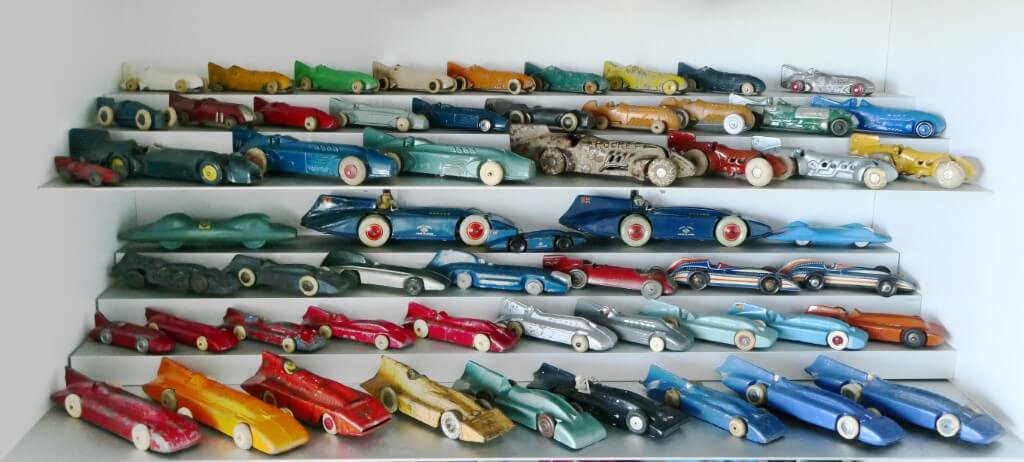
Photograph: A selection of toys from the author's collection
It took Malcolm Campbell’s 1928 Land Speed Record at Daytona Beach in the USA to capture the attention of the toy manufacturers. His previous exploits and records established in Europe didn’t get modelled until the 1970s when artisans started producing collectible scale models of Campbell’s earlier record holders, about which, more later.
Boys comic December 3rd 1927
Quite what Nelson Lee's young readers thought of the accuracy of this "real metal model" of the 1927 BB, shown immediately below, is hard to know. Boys had to bend a flat sheet of lithographed "Tinplate" to make this model. Clearly the results were not highly valued by young boys and these are now very hard to find.
The 1928 LSR holder was modelled in both slush molded and diecast lead as well as Zamak and cast iron - mostly in small scales. Kingsbury produced a beautiful 19 inch tinplate (actually pressed steel) in 1928. With a clockwork motor and produced with Campbell’s approval . Tootsietoys didn’t get their small lead and Zamak Models to market until 1932 but there were a variety of slush molds produced around the same time and for some years afterwards mostly in the USA. I also have a couple of small Danish ones.
This tinplate given away by "Modern Boy" allthough only a "flat" is far more realistic than the Nelson Lee model.
A selection of tootsietoy 1928 BBs. These were never described as BBs in their advertising. In fact those with numbers on their tails were included in a boxed set with a racing game where eight BBs were arbitrarily named as Cadillac.
March 16th 1929March 10th 1929
USA Hubley Diecast Marked Hubley. Rubber-wheels/tyres 95mm.
There were plenty of models of the 1931 to 1933 record holders in a variety of scales and materials as can be seen here along with some jigsaw puzzles, books and ephemera.
Gunthermann Germany tinplate clockwork 38cm
USA Unknown Maker Slush Mold. Lead-wheels/tyres. 67mmUSA. Lincoln Slush Mold. Rubber tyres Wooden wheels 152mmUSA Lincoln Slush Mold. Rubber-wheels/tyres 152mmUSA Kilgore. Cast Iron. Rubber tyres on nickel wheels. This, the largest of the three similar Kilgoretoys, has the word “Rocket” in raised script on the top 164mmUSA Kilgore Cast Iron. Rubber tyres on nickel wheels 110mmUSA Kilgore Cast Iron Identical in construction details to its two Kilgor sisters this is the mid sizedtoy 122mmUSA Kilgore Cast Iron Showing the clip holding together the two body halves and axlesUSA Barclay? Slush Mold Rubber-wheels/tyres. 104mmUSA Lincoln. Slush Mold. Rubber-wheels/tyres. 100mmUSA Lincoln Slush Mold Rubber-wheels/tyres 100mmUSA. Lincoln. Slush Mold. Lead-wheels/tyres. 100mmSweden Unknown Maker Diecast Lead. Nickel Plated. Rubber tyres on lead wheels. 111mm
England. Johillco. Diecast lead Lead-wheels/tyres. Not as finely cast as the later 1935 BB byBritains but still a good basic model 178mmDecember 2nd 1933March 26th 1932
It is the 1935 version which pushed the LSR to over 300mph that really caught the eyes of the world’s toymakers. I have versions in lead, Zamak, plaster, plastic, “flour and plaster” and tin, in sizes ranging from 6cm to about 30 cm and from about 20 different manufacturers in England, France, Germany, Japan and the USA.
Another jigsaw puzzle.
Cavacraft USA a wooden kit of parts that required sanding to shape.
USA. Lincoln. Slush Mold. Like many Lincolns this toy is more finely and crisply cast than most other American slush. 157mmUSA. Barclay. Slush Mold. No maker’s mark. Rubber- wheels/tyres. 176mmUSA. Lindstrom Tin clockwork. Marked “Lindstrom made in USA” Wooden wheels, rubber tyres. Sold in at least 8 different colours, with and without clockwork motor. 150mmJapan Unknown Manufacturer. Tin clockwork. Marked “Foreign” these were issued in a variety of colours. 148mmUnknown manufacturer. Plastic, moulded in various colours. No maker’s mark. Bakelite-wheels/tyres. 149mmMarked “Made in England Britains Ltd” and issued as number 1400. Lead. Pre war. This is the second version issued after Malcom Campbell pushed the LSR to 301.1292mph. Of all the toy BBs, Britains were the only company to correctly model the off centre driving position and with its detailed chassis it is definitely more a model than a toy. Rubber tyres on lead wheels. Clearly these were boys’ treasured possessions as quite a few have survived. 162mm.Marked “Made in England Britains Ltd” this is the first and much rarer version #1393 issued without the lift off body revealing the detailed chassis. The box specifies the record achieved as 276.8 mph. 162 mmThe underside of fig. 48Underside views of fig.48 (below) and 50 (above)Marked “Made in England by Britains Ltd” Lead. Pre war. This is a 3rd and smaller version of the same car. I do not know whether it was issued before or after #1393 but suspect that it was dropped from production when Britains issued the version with the detailed chassis. It is very hard to find. 137mmUnderside view of fig. 50Marked “Marklin Germany” on its Tin base plate. Pre war. Diecast with diecast wheels and rubber tyres. The rubber driver was sold separately as an accessory. Many early Marklins are subject to bad fatigue and actually fall apart. This one is fine but the rubber tyres have perished quite badly.Possibly English? Unknown manufacturer. Thick Lead casting. Lead-wheels/tyres 89mmUSA. Lincoln. Pre war Slush Mold. Rubber-wheels/tyres. 115mmUSA Unknown Manufacturer. Pre war Slush Mold Similar to the Barclay in fig.58 but with many subtle differences when examined closely. No maker’s mark Rubber-wheels/tyres. 110mmUSA Barclay BV120. #306. Pre war. Slush Mold. No maker’s mark. Rubber-wheel/tyres. 110mmUSA. Bestoy. Pre war. Slush Mold. “97” cast on tailfin. Plasticwheels/tyres are probably replacements. 113mmUSA. Ralston? Tiptoptoys? Pre war. Slush Mold. Marked “Made in USA” Rubber-wheels/tyres. 112mmUSA. Eccles. Post war, Slush Mold. Heavily cast (like most Eccles) reproduction of fig.60 Plastic-wheels/tyres. 112mmFrance. AR Pre war. Diecast lead. Marked “A R” Rubber tyres on lead wheels 123mmUnderside view showing the clockwork motor of car in fig.62France Marked “A R” on the underside. Pre war. Diecast lead. With replacement plastic tyres.Underside view of car in fig.64 showing that this is the version with no clockwork motor and no winding key hole.France JRD. “Plaster & Flour”. Pre war. No maker’s mark. Rubber tyres on lead wheels. 123mmEngland Charbens Lead At rear Lead-wheels/tyres, front lead wheels rubber tyres. certainly produced just after the war perhaps pre war as well?The undersides of fig.68 I don’t know what the two ridges on the underside of the top version are for. Marked “Charbens made in England” These models are quite rare.England Unknown Maker. Plaster composite. Marked “British Made” Rubber-wheels/tyres 130mmProbably England. Unknown Maker. Plaster composite. No Maker’s mark. Lead-wheels/tyres. 141mmEngland ? Unknown Maker. Tin. No maker’s mark. Tin-wheels/tyres. 125mmJapan ? Unknown Maker Tin. Marked “Foreign” Tin-wheels/tyres. The one in front with crossed flags has no base plate. 130mmThe underside view of the toys in fig. 75. I don’t know if the base plate is lost or if the toy was made like this.
The two Britains BB boxes. Interestingly, the end view of No. 1400 shows a peeling corner. I have deliberately left this unglued as it shows that the label is stuck down over a No.1393 label. Undoubtedly the news that Campbell’s new 1935 LSR had exceed 300mph was exciting enough for Britains to rush out a newer version of the model with the beautifully detailed chassis.
December 9th 1933
After the second world war Donald, Malcom Cambell' son took out...
England Jetex. Plastic, powered by Jetex rocket cartridges the car runs straight along a fixed fishing line run between the two tether lugs on the left side. 163mmEngland. Corgi 153 1960 Diecast. Turned aluminium wheels with rubber tyres. Re-issued in 1963 as 153a with Black plastic wheels/tyres. 127mm
Hong Kong Marx Toys Clearly one for the dedicated BB collector Plastic. 230mm
From the 1970s onwards collectors’ 1/43 scale models were available in resin and white metal. Artisan producers took advantage of resin molding and low temperature, white metal, centrifugal casting in rubber molds to produce small runs of models for niche collectors. Western Models produced a series of white metal LSR holders and these were quite widely available as compared to many of the smaller artisan’s productions which were quite hard to obtain even contemporaneously. Quality varied amongst these early manufacturers. People like Ugo Fadini in Italy, John Shinton and Ralf Foster (Pandora) produced some of the finest series of Bluebirds and other LSR cars. For the first time collectors could realistically aim to collect all the Land Speed Record holders from 1898 to the present day in a constant 1/43 scale. The very few early cars that have not yet been produced will most likely be available in coming years from the handful of specialist/enthusiast producers such as Touchwood Models who specialise in supplying LSR collectors.
Italy. Ugo Fadini. Resin. Hand built by Ugo. 136mEngland. Pandora. Resin. Hand built by Ralf Foster. 145mForeground. England. Pandora . Resin. Ralf Foster Hand built. 145mm Background. Italy. Ugo Fadini.England. Touchstone Models. White Metal. Hand built by Stuart Delf. 133mEngland. Touchstone Models. White Metal. Hand built by Stuart Delf. 140mEngland. Pandora. White Metal kit. 154mEngland. Pandora. White Meta. Hand built by Ralf Foster. 142mmEngland. Pandora. White Meta. Hand built by Ralf Foster. 142mmEngland. Milestone Miniatures ?? White Metal. Hand Built. 126mEngland. Pandora. White Metal. Hand built by Ralf Foster.England. Pandora. White Metal. Hand built by Ralf Foster.England. Phil Edwards. Resin. Hand Built. Unique set signed by Ken Norris BB designer Resin 195mEngland. Phil Edwards. Resin. Hand Built. Unique set signed by Ken Norris BB designer Resin 195mEngland Mach One Models. Resin kit 211mEngland. Western Models. White metal kit. 200mmEngland. Western Models.White Metal kit. 191mEngland. Replicast. Resin. Hand built by Geoff Brown. 197mEngland. Mach One Models. Resin kit. 210m
It is also fair to say that with the passing of time production techniques have improved and new brands have grown up to exploit the possibilities of photo etched steel, tampo printing and 3D prototyping. Amongst these Bizarre and Spark (brands with which the we are associated) have consistently improved on models previously issued by other manufacturers in years past as well as bringing out new exclusive models.
Paolo Rampini of Italy produced some of the very earliest resin models. These appear to have been scaled to sit alongside models by Britains, Johillco, Dinky and Corgi. They are now very hard to find and valued by LSR collectors perhaps more for their rarity and charm, rather than accuracy or detail.
There were also small wooden hand carved models produced by RD Marmande and Mercator in France. While these were comparatively crude, they did capture the essence of the prototypes and today they have enormous charm.
The pictures here are marked as my own or else culled from the Internet.