
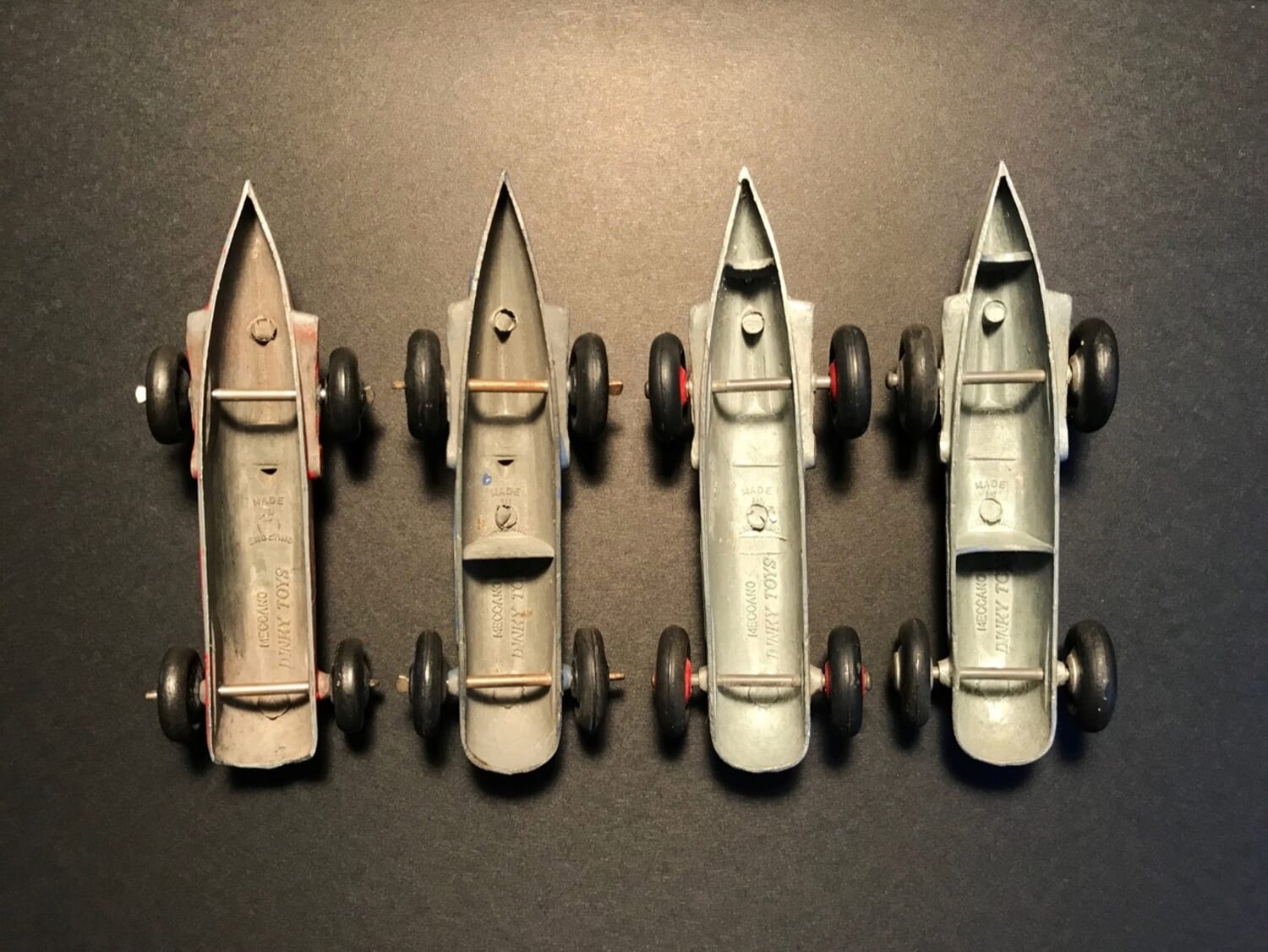
They have to be turned over to see the four different bulkhead configurations that evolved as the molds were used between the resumption of postwar production until deletion from the catalogue in 1956.
The two photos below are bottom and top views in the same sequence from above and below.
From left to right; No bulkhead, One bulkhead between the axles, One bulkhead behind the rear axle and finally on the right Two bulkheads behind and in front of the rear axle. I do not know in what sequence these all appeared but the first model (red and cream) on the left below was produced immediately post war as evidenced by its smooth pre war wheel hubs.
These castings differ from the pre war versions in that the raised cast circles around the racing numbers have been deleted. All the pictures below are from the internet and I have no copyright.
The first picture below, has the smooth hubs of the pre war models. The subsequent pictures all have the typical pre war ridged hub. There were far less color variations post war and as for the racing numbers there were either none or else they all seem to have carried the Number 4 in the same color as the body within a contrasting stenciled circle colour.
The silver and red version immediately above is by far the most common model and the easiest to find in good condition.
The many wonderfully colorful Zamak pre war models are unfortunately notoriously prone to "metal fatigue" which has resulted in many of them blistering, cracking or even crumbling into pieces. This, along with the fact that they were cheap and often played with roughly has meant that the relatively few survivors are highly sought after. Fortunately the rarest pre war models cast in lead do not "fatigue" however having been produced in very small numbers for only a short period they are rare and particularly so in good original condition with unchipped paint.
Collectively the 23, 23a and 220 had the longest production run of any Dinky Toy.